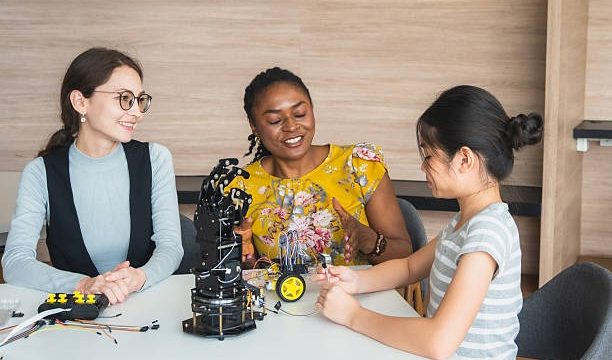
In a world that often feels dominated by screens and technology, finding creative ways to engage children in learning can be a delightful challenge.
One of the most effective paths to nurturing a love for math is right under our noses—in our own homes.
By using everyday household items, we can turn mundane moments into exciting learning opportunities. This approach not only makes math concepts tangible but also fosters a sense of curiosity and playfulness in children.
The beauty of teaching math using household items lies in the simplicity and accessibility of the materials. From your kitchen to your living room, a variety of objects can illustrate mathematical principles in ways that resonate with children. Whether you’re measuring ingredients for a recipe or sorting laundry, the possibilities are endless.
Consider the kitchen as a treasure trove of learning opportunities. Measuring cups and spoons can introduce the concept of fractions in a hands-on way. As children help with cooking or baking, they can practice measuring out ingredients, discussing how one cup is divided into two half-cups or four quarter-cups. This not only reinforces their understanding of fractions but also builds their confidence in the kitchen—a skill that will serve them well in the future.
Beyond fractions, cooking can also be a fantastic platform for exploring addition and subtraction. If a recipe calls for three eggs and you only have two, engage your child in finding out how many more you need. This real-life application of math makes the subject feel relevant and necessary, transforming abstract numbers into tangible problems to solve.
Moving beyond the kitchen, the living room can be another rich environment for mathematical exploration. Take a moment to gather some toys—blocks, action figures, or even stuffed animals. These items can be used to teach counting, grouping, and basic addition. For instance, you might create a little scene where your child has to group toys by color or size, counting each group as they go. This not only reinforces counting skills but also introduces concepts of classification and organization, which are foundational in mathematics.
As you play, encourage your child to think critically. Ask questions like, “If we have five red blocks and three blue blocks, how many do we have in total?” This kind of dialogue nurtures their problem-solving skills and encourages them to articulate their thought processes, further deepening their understanding.
Another delightful way to incorporate math into daily life is through shopping trips. When you head to the grocery store, engage your child in budgeting and price comparison. Give them a small amount of money and let them choose how to spend it. They can calculate how many items they can buy within their budget or figure out what items offer the best value. This not only teaches them about addition and subtraction but also introduces them to the concept of money and its practical applications in life.
Even the act of setting the table can become a lesson in math. Involve your child in counting out the number of plates, forks, and glasses needed for each family member. You can discuss concepts such as even and odd numbers, and even practice simple multiplication if you have guests joining for dinner. This turns a routine task into a fun and engaging math activity.
Gardening can also provide a unique opportunity to teach math concepts. If you have a garden or even a few plants in pots, use them to explore measurements and geometry. Discuss the spacing between plants, the area of your garden bed, or even the growth of plants over time. Measuring the height of plants or the amount of water they need can introduce concepts of measurement and data collection in a natural and enjoyable way.
As seasons change, so do the opportunities for math learning. Autumn brings a bounty of leaves, and collecting them can be a wonderful way to explore sorting and patterns. Encourage your child to group leaves by size, color, or shape, and then count each group. This sensory experience not only supports math skills but also deepens their connection with nature.
Even on rainy days, there are countless ways to incorporate math into play. Puzzle games and board games often require counting, strategy, and critical thinking. Playing cards can be a fantastic way to introduce concepts of probability, while simple games like tic-tac-toe can teach about grids and coordinates. These activities create a fun and relaxed atmosphere where math feels less like a chore and more like an exciting challenge.
As you explore these various activities, it’s important to emphasize the joy of learning. Celebrate small victories and encourage questions. Acknowledge that it’s perfectly okay to make mistakes, as they are often the best teachers. By creating a supportive environment, you can help your child develop a positive attitude toward math, transforming it from a subject to be feared into one to be embraced and enjoyed.
Ultimately, the goal is to weave math into the fabric of everyday life, making it a natural and enjoyable part of your child’s world. By using household items to teach math concepts, you not only enhance their understanding of numbers but also strengthen the bond you share through shared experiences and discoveries. With each lesson, you are not just teaching math; you are nurturing a lifelong love of learning that will serve them well in all areas of life.